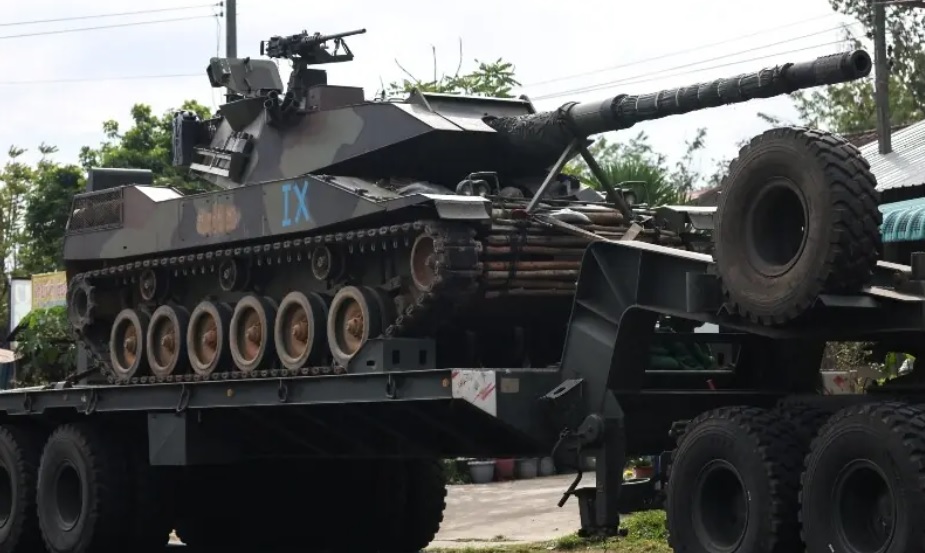
BANGKOK, December 27 (TNF): Thailand and Cambodia have agreed to a ceasefire aimed at halting weeks of intense border fighting that marked the worst clashes between the two Southeast Asian neighbours in years. The agreement, reached on Saturday, brings an end to nearly three weeks of violence that included fighter jet sorties, rocket fire, and heavy artillery exchanges along disputed sections of their shared frontier.
According to our correspondent in Bangkok, the ceasefire was formalised through a joint statement issued by the defence ministries of both countries. The statement confirmed that both sides would maintain their current troop deployments and avoid any further military movement along the border.
“Both sides agree to maintain current troop deployments without further movement,” the joint statement said. It warned that any reinforcement of forces could escalate tensions and undermine long-term efforts to resolve the dispute. Cambodia’s Defence Ministry released the statement on social media shortly after the agreement was signed.
The truce was signed by Thailand’s Defence Minister Natthaphon Nakrphanit and his Cambodian counterpart Tea Seiha. The agreement ends 20 days of sustained fighting that left at least 101 people dead and displaced more than half a million civilians on both sides of the border.
The latest clashes reignited in early December after a previous ceasefire collapsed. That earlier truce, brokered in July with the involvement of US President Donald Trump and Malaysian Prime Minister Anwar Ibrahim, had temporarily halted fighting that erupted during the summer. However, mutual accusations of violations led to renewed hostilities.
Thailand and Cambodia have disputed sections of their 817-kilometre land border for more than a century. Several areas along the frontier remain undemarcated, and disagreements over sovereignty have periodically flared into armed confrontations. Analysts say the unresolved border issue remains a persistent source of instability despite repeated diplomatic efforts.
Under the new ceasefire arrangement, observer teams from the Association of Southeast Asian Nations will monitor compliance. In addition, both governments have agreed to establish direct communication channels between their defence ministries and military leaderships to manage tensions more effectively.
“At the policy level, there will be direct communication between the minister of defence and the chiefs of the armed forces of both sides,” Natthaphon told reporters in Bangkok. He said such coordination would help prevent misunderstandings and allow for rapid de-escalation if incidents occur.
The agreement also addresses humanitarian concerns arising from the conflict. Both sides committed to facilitating the return of displaced civilians to their homes in border areas. The joint statement stressed that neither country would use force against civilians, reflecting growing concern over the human cost of the fighting.
Thailand further agreed to return 18 Cambodian soldiers who have been in Thai custody since clashes in July. This transfer will take place if the ceasefire holds for at least 72 hours, according to the terms outlined in the agreement.
Despite the breakthrough, the ceasefire does not resolve the underlying border dispute. Saturday’s pact made clear that existing border demarcation activities will continue through established bilateral mechanisms. Officials from both countries acknowledged that the sensitive issue of territorial claims remains unresolved.
The renewed talks followed a series of diplomatic efforts earlier this week. Southeast Asian foreign ministers held a special meeting in Kuala Lumpur on Monday, after which Thai and Cambodian officials engaged in three days of negotiations at a border checkpoint. The defence ministers met in person on Saturday to finalise the ceasefire.
The conflict had expanded significantly after resuming in December. Fighting spread from forested regions near Laos to coastal provinces along the Gulf of Thailand, raising fears of a wider regional crisis. Neither Trump nor Anwar, who currently serves as ASEAN chair, was able to broker a ceasefire during the renewed fighting.
Thailand’s Air Chief Marshal Prapas Sornjaidee welcomed the truce and urged calm. “War and clashes don’t make the two countries or the two people happy,” he said. He emphasised that ordinary citizens on both sides of the border were not enemies.
As reported by our correspondent in Bangkok, regional observers cautiously welcomed the agreement but warned that sustained political will and confidence-building measures will be crucial to prevent future flare-ups. While the ceasefire has halted the immediate violence, long-term peace will depend on addressing the deep-rooted border dispute that has strained Thai-Cambodian relations for generations.

 English