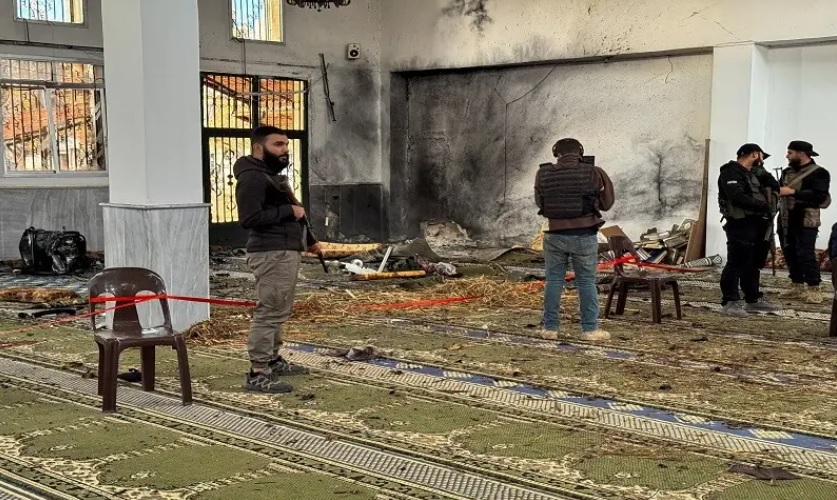
HOMS, December 26 (TNF): At least eight worshippers were killed and several others wounded after a powerful explosion tore through a mosque in the Syrian city of Homs during Friday prayers, deepening fears of sectarian violence and insecurity in the country.
The blast struck the Imam Ali Bin Abi Talib Mosque in the Wadi al-Dahab neighbourhood, a predominantly Alawite area of central Homs. State media reported that the explosion occurred while worshippers were gathered inside the mosque, triggering scenes of panic and devastation.
Syrian state news agency SANA quoted a health ministry official as saying that at least eight people were killed and 18 others injured. Officials warned that the death toll could rise as some of the wounded remained in critical condition.
Security forces quickly sealed off the area surrounding the mosque. Witnesses said debris, shattered glass, and blood covered parts of the prayer hall. An AFP photographer at the scene saw blackened walls and red tape marking the spot where the blast occurred.
A militant group calling itself Saraya Ansar al-Sunna claimed responsibility for the attack in a statement posted on Telegram. The group said its fighters detonated multiple explosive devices inside the mosque. Authorities have not independently confirmed the claim.
The group emerged after the ouster of former Syrian president Bashar al-Assad last year. Assad belongs to the Alawite minority, the same community targeted in the Homs attack. Saraya Ansar al-Sunna had previously claimed responsibility for a suicide bombing at a church in Damascus in June that killed 25 people, although Syrian authorities later blamed the Islamic State for that attack.
Syria’s interior ministry described the mosque blast as a “terrorist explosion.” In a statement, it said investigators had begun collecting evidence and would pursue those responsible for what it called a criminal act. A security source cited by SANA said initial findings pointed to explosive devices planted inside the mosque.
Survivors described terrifying moments as the blast ripped through the building. Usama Ibrahim, 47, who suffered shrapnel wounds to his head and back, said he was praying when he heard a loud explosion. “The world turned red, and I fell to the ground,” he said from his hospital bed. “Then I saw blood flowing from my head.”
Another wounded worshipper, Ghadi Maarouf, 38, said the explosion happened just before the imam was about to begin the sermon. “It was a huge blast,” he said. “I saw shrapnel flying all around me.” Maarouf suffered injuries to his leg.
Syria’s foreign ministry condemned the attack as a “cowardly criminal act.” In a statement, it said the bombing formed part of repeated attempts to spread chaos and undermine security. The ministry reaffirmed its commitment to combating terrorism and vowed to hold those responsible accountable.
Several regional countries, including Saudi Arabia, Lebanon, Turkey, and Jordan, issued statements condemning the attack and expressing solidarity with the victims.
The bombing adds to growing concern among Syria’s Alawite community, which has faced a wave of violence since Assad’s fall. Rights monitors and local residents have reported kidnappings and killings targeting Alawites, alongside broader sectarian unrest across the country.
Earlier this year, Syria’s coastal regions witnessed mass killings of Alawite civilians. Authorities accused armed Assad loyalists of triggering the violence by attacking security forces. A national commission of inquiry later said at least 1,426 Alawites were killed. The Syrian Observatory for Human Rights placed the toll at more than 1,700.
Protests erupted along the coast last month after new attacks in Homs and other regions. Demonstrators accused authorities of failing to protect minority communities.
Before and after the coastal violence, security forces launched mass arrests in Alawite-majority areas, many of which were former Assad strongholds. On Friday, Syrian state television reported that 70 detainees were released in the coastal city of Latakia after investigations found no evidence linking them to war crimes. Officials said further releases would follow.
Despite repeated assurances from Damascus that all communities will receive protection, minorities across Syria remain deeply anxious. In July, sectarian clashes in the Druze-majority province of Sweida killed more than 2,000 people. Rights monitors said hundreds of Druze civilians were summarily executed during the violence.
In a recent speech marking one year since Assad’s fall, Syrian President Ahmed al-Sharaa urged Syrians to unite and rebuild the country. He stressed national unity as essential for Syria’s recovery.
Despite diplomatic gains abroad, the new leadership faces a growing domestic challenge. Maintaining security and preventing sectarian bloodshed now stand as the most urgent tests.
As reported from Homs, the mosque bombing has sent shockwaves through the city and renewed fears that Syria’s fragile stability remains under serious threat.

 English