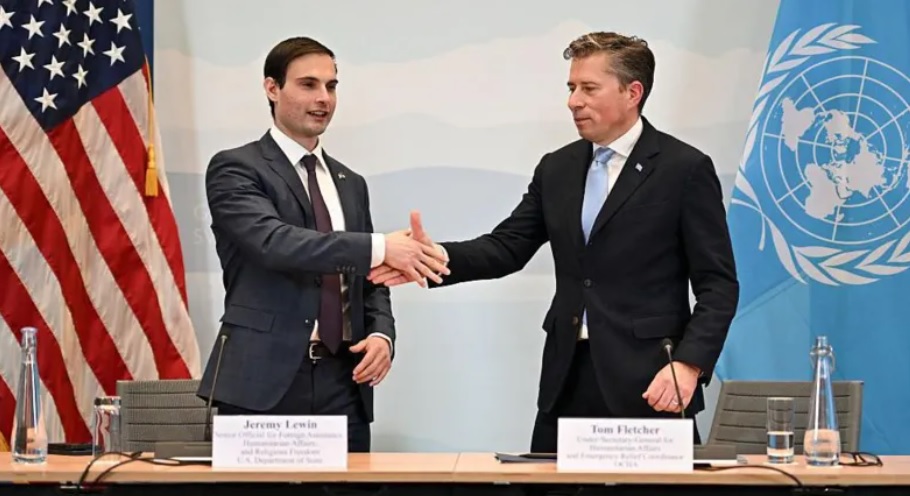
GENEVA, December 29 (TNF): The United States has announced a $2 billion pledge to support United Nations humanitarian programmes, while delivering a blunt message to the global body to reform its systems or risk losing future support. The announcement was made in Geneva amid mounting pressure on international aid agencies facing shrinking budgets and growing global crises.
The pledge was unveiled by Jeremy Lewin, President Donald Trump’s Under Secretary for Foreign Assistance, alongside UN Emergency Relief Coordinator Tom Fletcher. While the funding was welcomed by UN officials, it marks a sharp reduction from previous levels of US humanitarian spending and comes with strict conditions.
In 2022, the United States contributed an estimated $17 billion to UN humanitarian efforts. The newly announced $2bn represents only a fraction of that figure, highlighting a broader shift in Washington’s approach to foreign aid under the Trump administration. Other major donors, including the United Kingdom and Germany, have also announced or signaled reductions, compounding pressure on an already strained global aid system.
Tom Fletcher said the new funds would help save millions of lives at a time when humanitarian needs are rising sharply. Conflicts, climate shocks and economic crises have pushed an estimated 200 million people worldwide into urgent need of assistance. However, he acknowledged that funding gaps remain severe and that agencies are being forced to make painful choices.
The US funding comes with clear limits. Aid will be prioritized for just 17 countries, including Haiti, Syria and Sudan. Afghanistan and Yemen have been excluded entirely. Lewin said Washington had evidence that UN funds in Afghanistan were being diverted to the Taliban, adding that President Trump would not allow US taxpayer money to reach terrorist groups under any circumstances.
These restrictions are expected to have serious consequences for aid agencies operating outside the approved list. In Afghanistan, funding shortfalls have already led to the closure of maternal and child health clinics. In Sudan, food rations for displaced communities have been reduced as resources dry up. Aid groups warn that similar cutbacks could spread to other crisis zones in the coming months.
The new US conditions also rule out funding for projects linked to climate change. Lewin argued that such initiatives are not life-saving and do not serve US national interests. This position puts Washington at odds with many humanitarian organizations, which increasingly see climate-driven disasters as a major driver of hunger, displacement and disease.
Lewin delivered the administration’s warning in stark terms, saying the UN must “adapt or die.” He said the United States would no longer act as a financial backstop for agencies that resist reform or cling to outdated systems. According to him, the era of automatic funding is over, and aid must now be focused, efficient and free from duplication.
US officials say they want clearer results, tighter oversight and measurable impact from every dollar spent. They argue that reform is essential to maintain public support for foreign aid at home and to ensure assistance reaches those who truly need it.
UN officials say they share the goal of efficiency and accountability. Fletcher stressed that no one benefits from wasted resources, especially people trapped in conflict zones or humanitarian emergencies. He said the UN has already launched internal reforms aimed at improving coordination, cutting bureaucracy and reducing overlap between agencies.
Still, concerns remain within the humanitarian community about the growing politicization of aid. The core principles of humanitarian action are neutrality, impartiality and independence. Critics argue that excluding entire countries or crises undermines these principles and risks leaving vulnerable populations without help.
The UN now faces a difficult balancing act. It must secure funding from increasingly skeptical donors while defending humanitarian norms that have guided global relief efforts for decades. For many inside the organization, the $2bn pledge is both a lifeline and a warning.
As funding pressures mount and global needs continue to rise, UN officials privately acknowledge that accepting tough conditions may be unavoidable. For now, they are focusing on keeping essential programmes running and preventing further loss of life, even as debates over reform, fairness and independence intensify.
 English