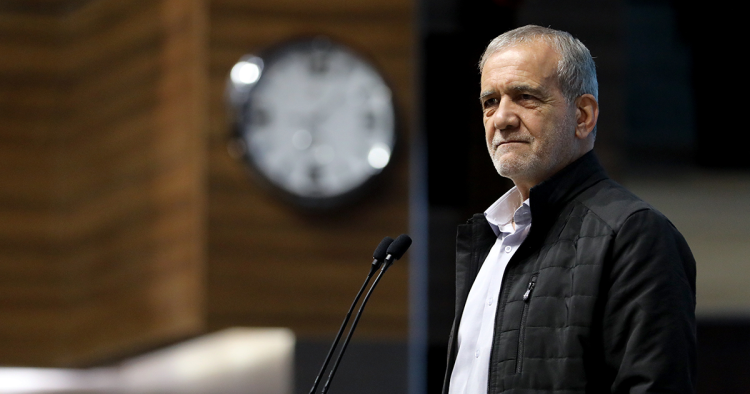
TEHRAN, December 28 (TNF): Iran is engaged in what it describes as a “comprehensive war” with the United States, Israel and several European countries, Iranian President Masoud Pezeshkian said, warning that the current confrontation is more complex and dangerous than past conflicts.
In an interview published on Saturday on the official website of Iran’s Supreme Leader Ayatollah Ali Khamenei, Pezeshkian said Iran now faces a form of warfare that goes far beyond traditional military confrontation. The remarks were reported by TRT World.
“We are in a state of comprehensive war with the United States, Israel, and Europe,” Pezeshkian said.
“This war is more dangerous, more complex, and more difficult than the war with Iraq between 1980 and 1988,” he added.
The Iranian president argued that the nature of conflict has changed dramatically. Unlike the Iran-Iraq war, where battle lines were clear and attacks were direct, Pezeshkian said today’s confrontation involves economic pressure, political isolation and psychological strain on society.
“During the war with Iraq, the situation was clear,” he said. “They fired missiles, and we knew where to strike. Today, the pressure comes from all sides.”
Pezeshkian accused the United States, Israel and some European countries of working to weaken Iran through indirect means. He said these countries are using sanctions, trade restrictions and political pressure to destabilize the country internally.
“They surround us from all sides,” he said. “They obstruct our trade, apply constant pressure, and raise public expectations inside society in different fields.”
According to Pezeshkian, this form of conflict aims to exhaust Iran economically and socially rather than defeat it through open warfare. He warned that such pressure tactics pose a serious threat to national stability.
The comments come against the backdrop of heightened tensions between Iran and Israel, with the United States increasingly drawn into the conflict.
In June, Iran and Israel fought a 12-day war, during which hostilities escalated rapidly. During that conflict, the United States carried out air strikes on three major Iranian nuclear facilities: Fordo, Natanz, and Isfahan.
The US military reportedly used bunker-buster bombs in the strikes, marking one of the most direct American military actions against Iran’s nuclear infrastructure in recent years.
Those attacks came more than a week after Israel launched its own military operation against Iran. Israeli strikes reportedly killed several senior Iranian military commanders and nuclear scientists, while also targeting nuclear-related sites.
Iran has repeatedly condemned the attacks as violations of international law and has accused Israel of attempting to provoke a wider regional war.
President Pezeshkian said the combined pressure from military action, economic sanctions and diplomatic isolation has created an unprecedented challenge for Iran.
“This is not just a military confrontation,” he said. “It is a war that targets our economy, our society and our future.”
Iran has long argued that Western sanctions, particularly those imposed by the US and supported by European allies, amount to economic warfare. Tehran maintains that these measures have harmed ordinary citizens by restricting access to trade, banking and essential goods.
European countries, meanwhile, have expressed growing concern over Iran’s nuclear programme and its regional activities, while also calling for restraint and dialogue.
The United States has defended its actions by saying they are aimed at preventing Iran from developing nuclear weapons. Iran has consistently denied seeking nuclear arms, insisting its programme is for peaceful purposes.
Despite repeated calls for negotiations, relations between Tehran and Washington remain deeply strained. Diplomatic efforts to revive nuclear agreements have stalled, while military and political rhetoric has intensified.
Pezeshkian’s remarks reflect a broader narrative within Iran’s leadership that the country is under siege from multiple fronts. Officials have increasingly framed sanctions, cyber operations and diplomatic pressure as elements of a coordinated campaign against Iran.
Analysts say such statements also serve a domestic purpose. By portraying the crisis as an external “comprehensive war,” Iranian leaders may seek to rally public support and justify internal economic hardships.
Regional tensions remain high, with fears that further escalation could draw in more countries and destabilize the Middle East.
As Iran, Israel and the United States continue to trade accusations and warnings, Pezeshkian’s comments underline how deeply entrenched and complex the confrontation has become, one that Tehran now views as a full-spectrum conflict rather than a conventional war.
 English