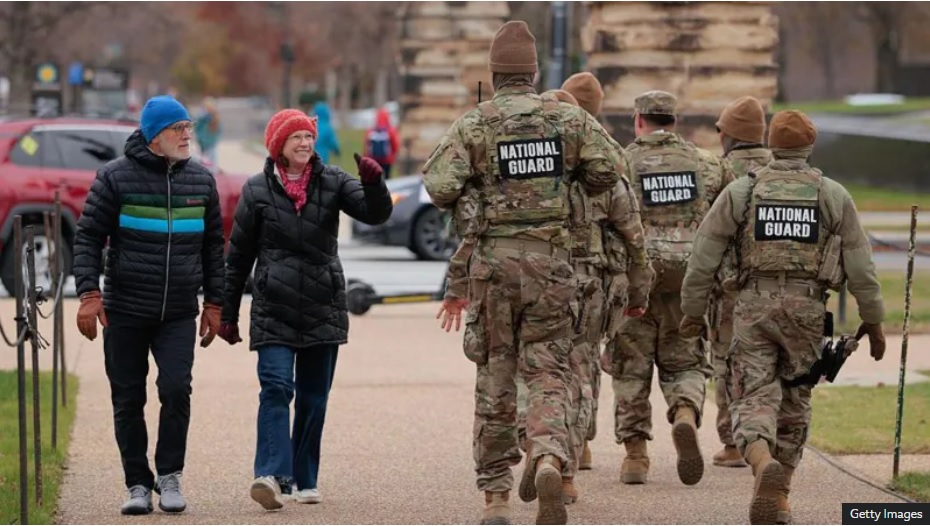
WASHINGTON, January 1 (TNF): US President Donald Trump has announced the withdrawal of National Guard troops from several major American cities, including Chicago and Los Angeles, following recent court rulings that curtailed his authority to deploy troops for domestic law enforcement.
In a post on his Truth Social platform late on New Year’s Eve, Trump said the decision was temporary and left the door open for future action. He warned that the federal government could return with greater force if crime rises again.
“We will come back, perhaps in a much different and stronger form, when crime begins to soar again,” Trump wrote.
The move follows a Supreme Court ruling last week that limited the president’s powers to deploy National Guard troops in cities without the consent of state authorities. In a landmark decision in Trump v Illinois, the court ruled that Trump did not have the legal authority to use troops for policing in Chicago.
Earlier this week, the Trump administration also withdrew its legal effort to retain control over National Guard units deployed in Los Angeles. That case had been challenged by California officials, who argued that the deployment violated constitutional limits on federal power.
Trump’s statement also referenced Portland, Oregon, where troops had been stationed but not actively deployed on city streets. He did not mention Washington, DC, where National Guard personnel remain on patrol.
The deployment of troops to Democratic-led cities had sparked intense legal and political controversy. National Guard units are typically commanded by state governors. Federal control is allowed only under narrow circumstances, such as insurrection or national emergency.
Hundreds of troops had been sent to Chicago and Portland earlier this year. However, due to ongoing court challenges, they had not been assigned routine patrol duties. Their presence remained largely symbolic while judges reviewed the legality of the deployments.
Trump has repeatedly defended the use of troops, saying they were needed to restore law and order, curb violent crime, and address illegal immigration. He argued that local leaders had failed to protect residents and that federal intervention was justified.
Critics strongly disagreed. Civil rights groups, Democratic leaders, and legal experts accused Trump of abusing executive power and using the military to intimidate political opponents. They warned that deploying troops for civilian policing threatened democratic norms and constitutional safeguards.
The Supreme Court ruling marked a major setback for Trump’s law-and-order strategy. The justices concluded that the president overstepped his authority by attempting to deploy troops in Chicago without state approval.
Following the ruling, the administration quietly withdrew its legal motion in California that sought to maintain federal control over National Guard units in Los Angeles.
California Governor Gavin Newsom welcomed the decision. In a post on X, he said the administration’s retreat signaled the end of what he described as an unlawful tactic.
“This admission by Trump and his inner circle means this illegal intimidation effort will finally come to an end,” Newsom wrote.
He added that Trump’s announcement resembled a political retreat rather than a voluntary decision. He described it as the equivalent of saying, “You can’t fire me, I quit.”
Chicago Mayor Brandon Johnson also praised the Supreme Court ruling. He said it showed that constitutional checks and balances were still functioning.
“There is at least one branch of government that recognizes the president’s overreach as a real threat to our democracy,” Johnson said in remarks to local media.
Despite the withdrawal, Trump signaled that he remains committed to aggressive federal action on crime. His warning about returning “stronger” suggests that the issue may resurface if crime statistics or political conditions change.
Legal analysts say the episode underscores growing tension between federal authority and state sovereignty. It also highlights the limits of presidential power when courts intervene.
For now, National Guard troops are leaving several cities where their presence had drawn sharp criticism and legal scrutiny. The debate over the role of the military in domestic law enforcement, however, is far from over.
 English