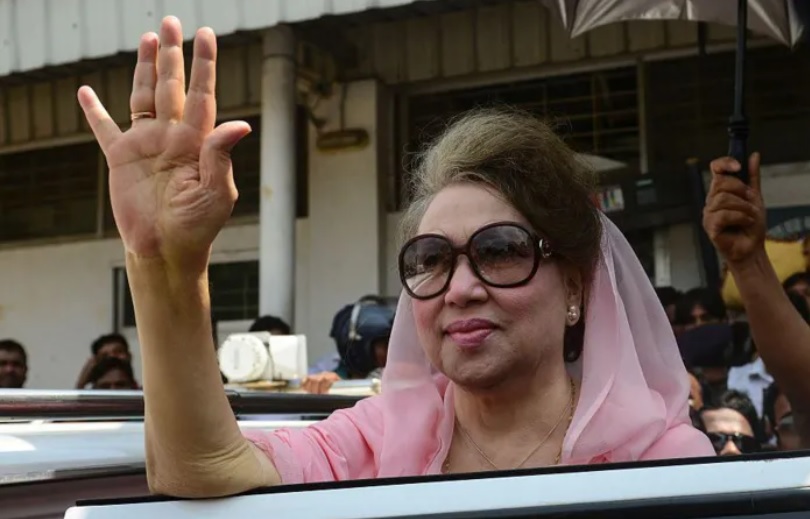
DHAKA, December 30 (TNF): Khaleda Zia, Bangladesh’s first female prime minister and one of the most influential figures in the country’s political history, has died today, after a prolonged illness. She was 80. Her death marks the end of a defining era in Bangladeshi politics shaped by intense rivalry, democratic struggle, and repeated political upheaval.
The Bangladesh Nationalist Party, which she led for decades, announced her death early Tuesday morning. The party said she passed away at 6am after doctors described her condition as extremely critical. She had been placed on life support at Evercare Hospital in Dhaka, where she had been receiving treatment. Physicians said her age and overall poor health made it impossible to administer multiple treatments at the same time.
As news of her death spread, supporters gathered outside the hospital. Many described her as a symbol of resistance and perseverance during years of political turmoil. Social media platforms filled with messages of mourning from party workers and political figures across the country.
Khaleda Zia was preparing to contest parliamentary elections scheduled for February, which were to be held after a popular uprising in late 2024 forced the removal of long-time leader Sheikh Hasina. Her planned return to electoral politics had carried strong symbolic weight for her supporters, who viewed her as a central figure in the post-revolution political landscape.
Her journey into politics began under tragic circumstances. She entered public life after the assassination of her husband, President Ziaur Rahman, who was killed in a military coup in 1981. Until then, she had largely remained in the background as the wife of a powerful military leader turned president. His death pushed her into a leadership role at a time when Bangladesh was deeply unstable.
In 1991, Khaleda Zia became Bangladesh’s first woman prime minister following the country’s first democratic election in two decades. Her victory also marked a historic moment in South Asian politics, where female leadership remained rare. She went on to serve three terms as prime minister, though her second term in 1996 lasted only a few weeks.
Her political career was inseparable from her long and bitter rivalry with Sheikh Hasina. The two women dominated Bangladeshi politics for more than three decades. Their feud shaped elections, street politics, and state institutions. Each accused the other of corruption, authoritarianism, and undermining democracy. The rivalry often paralyzed governance and polarized society.
Zia’s first full term in office was widely praised. Her government focused on expanding women’s education and improving social indicators. It also restored parliamentary democracy through a constitutional amendment passed with bipartisan support. Many analysts credit this period with stabilizing Bangladesh after years of military rule.
Her brief second term in 1996 proved controversial. The election that brought her back to office was boycotted by opposition parties, who demanded a neutral caretaker government to oversee polls. Facing mass protests, parliament approved the caretaker system before dissolving itself, leading to new elections months later.
Zia returned to power again in 2001 and served until October 2006. This period was marked by strong economic growth but also by widespread allegations of corruption. Her administration faced criticism both domestically and internationally, which weakened her political standing.
Over the next 16 years, as the Awami League consolidated power, Khaleda Zia became the most prominent face of opposition. Many supporters saw her as a counterweight to what they viewed as increasingly authoritarian rule. She boycotted the 2014 election after the caretaker system was abolished, arguing that fair elections were no longer possible.
In later years, Zia faced imprisonment and house arrest after being convicted on corruption charges. She denied all allegations and said the cases were politically motivated. Her health deteriorated in custody. She was allowed to travel abroad for treatment only after Sheikh Hasina lost power following the 2024 uprising.
Despite long absences from active politics, her influence never fully faded. For many supporters, she remained a symbol of democratic resistance and political endurance in a system dominated by personal rivalries and institutional weakness.
Khaleda Zia’s death closes a major chapter in Bangladesh’s political story. Her legacy remains contested. Admirers credit her with restoring democracy and empowering women. Critics point to political deadlock and governance failures. Yet few dispute her central role in shaping modern Bangladesh.
 English