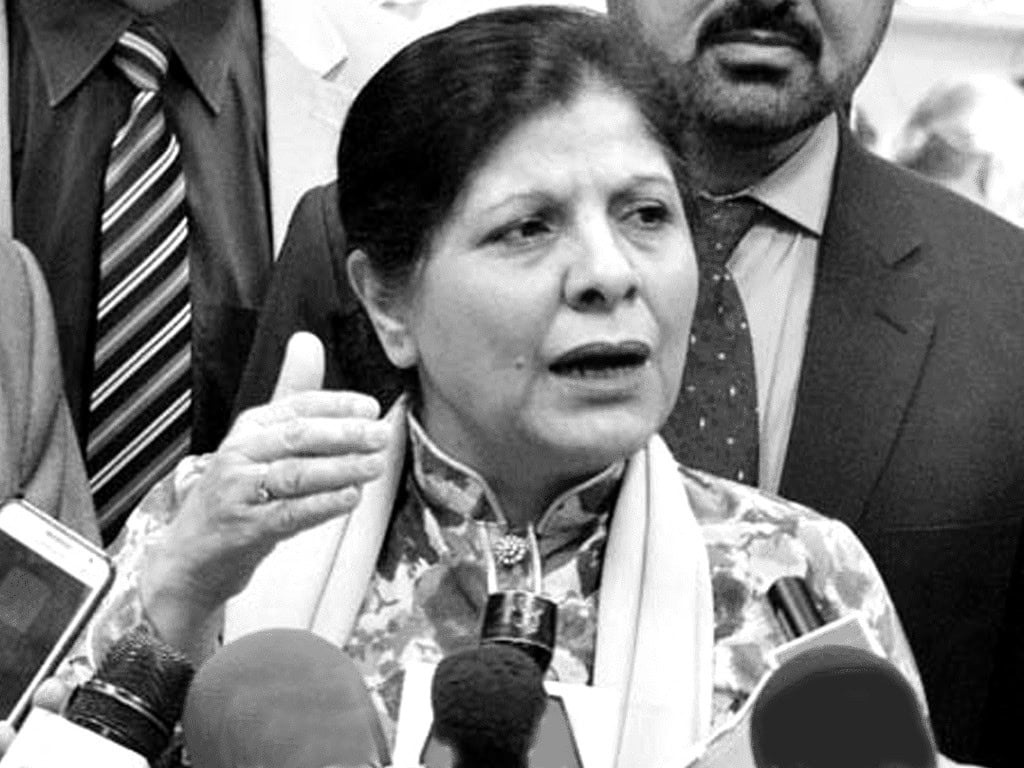
ISLAMABAD, December 27 (TNF): Renowned economist and former governor of the State Bank of Pakistan, Dr Shamshad Akhtar, passed away on Saturday after suffering a cardiac arrest. She was 71.
Dr Akhtar was widely respected in Pakistan and abroad for her contributions to economic policy, financial governance, and institutional reform. Her death marks the loss of one of the country’s most distinguished public sector economists.
She served as the 14th Governor of the State Bank of Pakistan from January 2, 2006. With that appointment, she became the first woman to lead Pakistan’s central bank, a milestone in the country’s financial history.
During her tenure at SBP, Dr Akhtar focused on strengthening monetary policy frameworks, improving banking supervision, and enhancing institutional independence. Colleagues and analysts credit her with steering the central bank through a challenging period marked by global financial uncertainty and domestic economic pressures.
Beyond her role at SBP, Dr Akhtar also served Pakistan as caretaker finance minister ahead of the 2018 and 2024 general elections. In those politically sensitive periods, she oversaw fiscal management with an emphasis on stability, continuity, and transparency.
Her career extended far beyond Pakistan’s borders. Dr Akhtar held senior positions at major international financial institutions and multilateral bodies. She served as Vice President of the World Bank for the Middle East and North Africa region, where she worked on development financing, governance reforms, and poverty reduction strategies.
She later became Executive Secretary of the United Nations Economic and Social Commission for Asia and the Pacific (ESCAP). In that role, she promoted regional cooperation, economic integration, and inclusive development across Asia and the Pacific.
Before joining the State Bank, Dr Akhtar worked at the Asian Development Bank. She served as Director General of ADB’s Southeast Asia Department from 2004 and also led the Governance, Finance and Trade Division for East and Central Asia. Her work there focused on financial sector reform and institutional capacity building.
Dr Akhtar was born in Hyderabad and received her early education in Karachi and Islamabad. She completed her Bachelor’s degree in Economics from the University of the Punjab in 1974.
She went on to earn a Master’s degree in Economics from Quaid-i-Azam University. She later obtained an M.A. in Development Economics from the University of Sussex in 1977 and completed her PhD in Economics from Paisley College of Technology in the United Kingdom in 1980.
Her academic career included a post-doctoral Fulbright fellowship and a visiting fellowship at Harvard University in 1987. Colleagues often described her as a rigorous thinker with a deep commitment to evidence-based policy.
Following news of her passing, leaders from Pakistan and international institutions paid glowing tributes.
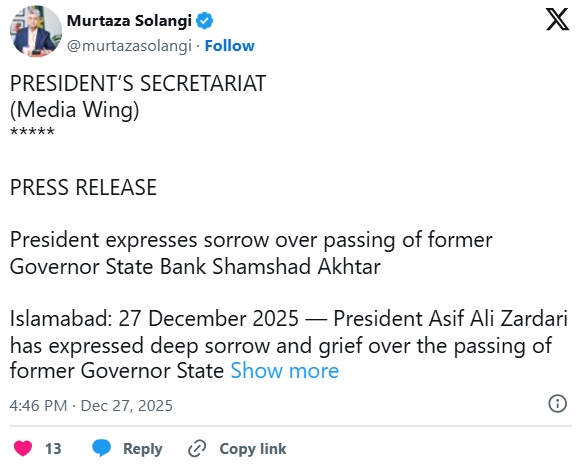
President Asif Ali Zardari expressed deep sorrow and acknowledged her contributions to economic governance and financial management. He said her services would be remembered as instrumental in strengthening Pakistan’s institutions.
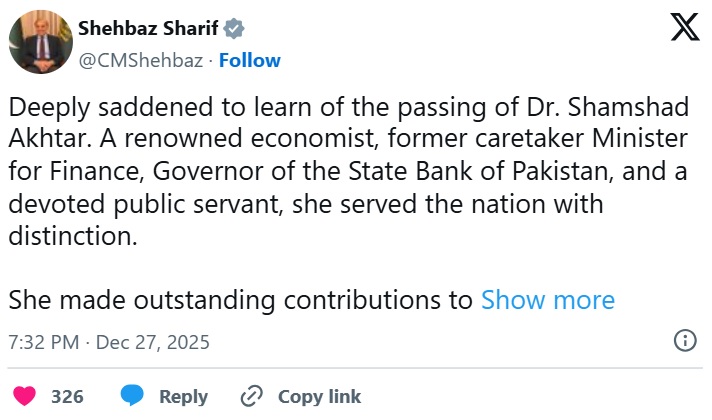
Prime Minister Shehbaz Sharif described her as a devoted public servant. He said she served the nation with distinction and made outstanding contributions to Pakistan’s financial architecture.
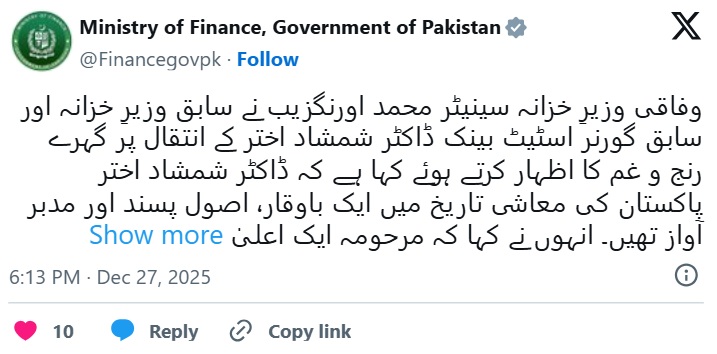
Finance Minister Muhammad Aurangzeb called Dr Akhtar a principled and dignified voice in Pakistan’s economic history. He praised her integrity, professionalism, and long public service.
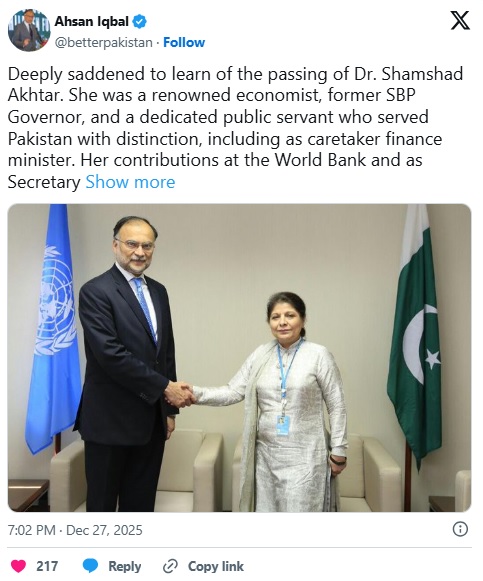
Minister for Planning and Development Ahsan Iqbal said he was deeply saddened by her passing and offered prayers and condolences to her family.
ESCAP, where Dr Akhtar previously served as executive secretary, said she worked steadfastly to strengthen regional cooperation and promote inclusive and sustainable development across Asia and the Pacific.
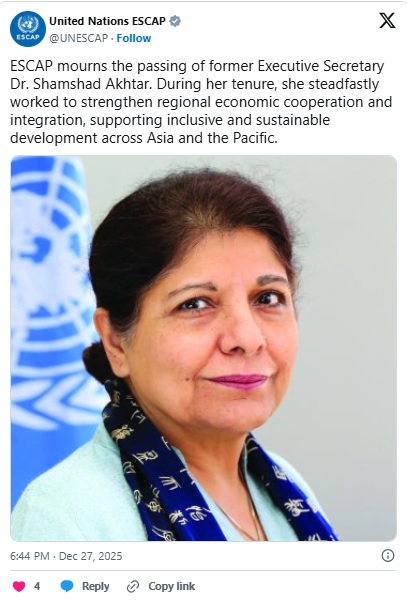
Dr Shamshad Akhtar leaves behind a legacy of integrity, competence, and public service. She broke barriers, strengthened institutions, and represented Pakistan with distinction on the global stage. Her passing is a profound loss to the country’s economic and policy community.


 English